

Most pest problems don't announce themselves. By the time you see a mouse cross the kitchen floor in daylight, it has usually been living in your house for weeks — mice are nocturnal, and daytime activity means the population has outgrown the quiet hours.
That's the pattern with almost every pest. The evidence shows up long before the animal does. Here are the seven signs Northern Illinois homeowners call us about most, what each one usually means, and how urgently it needs attention.
1. Droppings in cabinets, drawers, or along the walls
This is the single most reliable sign, and the one people most often mistake for dirt.
Mouse droppings are dark, roughly the size of a grain of rice, and pointed at both ends. You'll find them under the sink, in the back of a pantry, in a utensil drawer, or in a line along a baseboard. Rat droppings are noticeably larger — closer to an olive pit — and usually turn up in a basement, garage, or crawl space.
Fresh droppings are dark and soft. Old ones are grey, dry, and crumble when moved. If you're finding both, it means activity is ongoing rather than something that happened last winter.
What to do: Don't sweep or vacuum them. Both send particles into the air, and rodent droppings can carry hantavirus. Spray with a disinfectant, let it sit, then wipe up with a paper towel and gloves.
If you're finding droppings, you don't have a mouse. You have mice. Rodent control is the fix, and sealing the entry points matters more than the trapping.
2. Scratching or scurrying in the walls and ceiling
Noise is the sign that wakes people up — literally. What you hear tells you a lot about what you have.
Light, fast scratching after dark, usually in the walls, is typical of mice. They're most active in the few hours after sunset and again before dawn.
Heavier scampering during the day, especially overhead, points toward squirrels. They're diurnal, so daytime noise in the attic is a strong signal.
A slow, dragging sound or thumping suggests something bigger — raccoons or opossums.
What to do: If it's mice, that's us. Anything larger is wildlife, which our sister company Fur Busters handles. Either way, don't ignore it through the winter hoping it resolves. It doesn't, and animals in a wall void chew wiring.
3. Gnaw marks and chewed packaging
Rodent teeth grow continuously, so they chew constantly to wear them down — on cardboard, drywall, plastic storage bins, food packaging, and wiring insulation.
Look for small, paired scrape marks on the edges of cardboard boxes in the basement or garage. Check the corners of cereal boxes and pet food bags. Chewed wire insulation inside a wall or appliance panel is the one that matters most, because it's a genuine fire risk and it's the reason we tell people not to wait on this.
What to do: Move dry goods and pet food into hard plastic or glass containers with sealing lids. That removes the food source while the actual problem gets addressed.
4. Grease marks and rub trails along baseboards
This one is easy to miss and very hard to fake.
Rodents have poor eyesight and navigate by touch, running the same routes along walls night after night. The oil and dirt in their fur leaves a dark, greasy smudge on baseboards, along floor edges, and around the gaps they squeeze through.
A dark smear around a small hole where a pipe enters a wall is a confirmed entry point. That's the kind of detail our technicians look for during an inspection, because it tells you where to seal rather than where to guess.
What to do: Note where you see them and don't clean them off before an inspection. They're a map.
5. Sawdust piles, mud tubes, or wood that sounds hollow
Wood damage means one of two very different problems, and the treatments aren't interchangeable.
Small piles of what looks like sawdust — usually near a window sill, door frame, or deck post — is frass, and it points to carpenter ants. They don't eat wood; they excavate it to nest, and push the debris out. Frass often contains bits of insect body parts mixed in, which is how you tell it from actual sawdust.
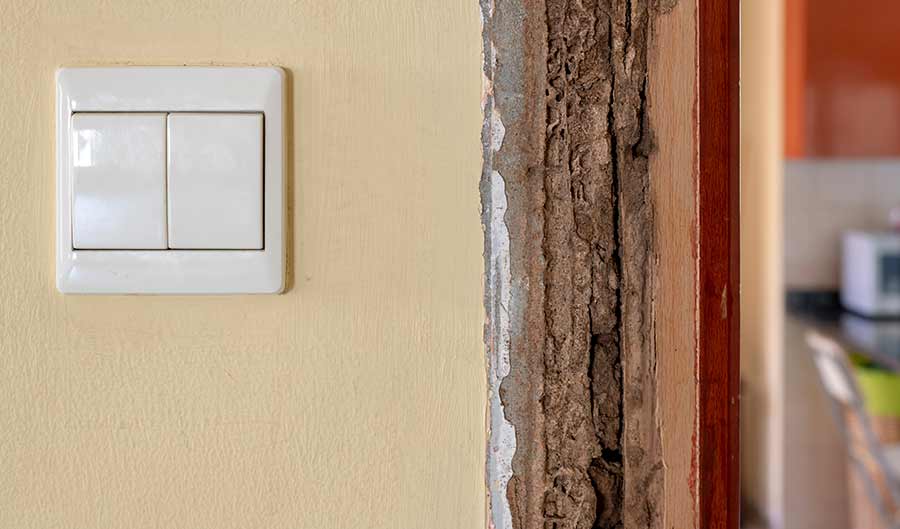
Pencil-width mud tubes running up a foundation wall or across a basement joist are termites. Subterranean termites build these to travel between soil and wood without drying out. If you break one open and it's repaired within a few days, the colony is active.
Wood that sounds hollow when tapped, or trim that gives under a screwdriver, means damage has been happening for a while regardless of which insect caused it.
What to do: These get treated differently, so identification comes first. Carpenter ant treatment targets a colony that may have satellite nests elsewhere on the property. Termite inspections produce a formal WDI report, which is also what lenders require during a home sale.
6. Insects showing up out of season, or in numbers
A single spider in October is a spider. Thirty ladybugs on the sunny side of your house in October is something else.
Northern Illinois has a predictable seasonal rhythm, and insects appearing off that rhythm — or all at once — usually means a nest or an overwintering population rather than a stray.
- Ants appearing suddenly in large numbers after rain often means a colony was flooded out of the soil and relocated toward your foundation.
- Boxelder bugs, Asian lady beetles, and stink bugs massing on south- and west-facing walls in late August and September are looking for a place to overwinter. Fall invader treatment has to happen before they get into the wall voids — once they're inside, treatment can't reach them.
- Wasp activity concentrated at one spot on the roofline or in the lawn means a nest, not passing insects. Stinging insect nests peak in size in late summer, which is also when they're most defensive.
- Insects indoors in the middle of winter almost always means they've been living in the structure, not that they came in from outside.
7. A smell you can't place
Odor is the last sign people connect to pests, and often the first one they notice.
A musty, stale smell in a basement or closet can be rodent urine and nesting material. A sharp ammonia note points the same direction and usually means a larger population. A sweet, rotting smell that gets worse over a few days and then slowly fades is a dead animal in a wall or under the floor.
Odorous house ants earn their name here too — crushed, they smell distinctly like rotten coconut, which is one of the few ways to identify them without a hand lens.
What to do: Smell without a visible source is worth investigating rather than covering. Air fresheners in a basement are usually a delayed pest call.
What actually resolves it
Every one of these signs points to the same underlying issue: something found a way in, and the way in is still open.
That's why treating the visible problem alone tends to buy a few weeks. Trapping thins a rodent population but the gaps stay open. Spraying a trail kills the ants you see while the colony continues. Knocking down a nest doesn't stop the next one being built in the same protected corner.
Our Quad Shield™ Protection System treats four zones — the property edge, the perimeter, the foundation, and the soffit line — because pests cross all four before they reach the last one. Six scheduled visits a year, timed to the local seasons, with free re-service in between if something gets through.
Seeing any of these?
If you recognized two or more of these signs in your own house, it's worth an inspection. Most of what we find is straightforward, and catching it early is the difference between a treatment and a repair.
Final Call Pest Solutions serves McHenry, Lake, and northern Kane counties — Woodstock, Crystal Lake, McHenry, Algonquin, Huntley, Barrington, and surrounding communities.
Call (224) 431-7955 or request a free quote.