

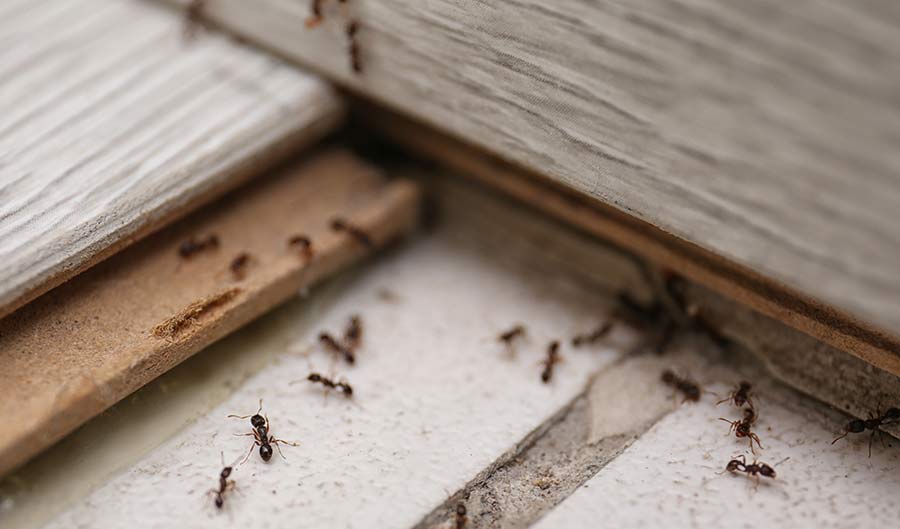
Ants, spiders, and mice are three completely different animals with three completely different biologies. But they get into your house for the same three reasons: there's a way in, there's water, and there's something to eat.
Change those conditions and you prevent all three at once. That's the whole idea behind prevention work — you're not chasing individual pests, you're making the building less useful to them.
Here's what actually moves the needle on a Northern Illinois home, and roughly when to do each piece.
Start with the gaps, because size is everything
A house mouse fits through a quarter-inch opening — about the width of a pencil. If you can slide a pencil into a gap, a mouse can follow it. Rats need about a half-inch. Ants and spiders need almost nothing at all.
That's why "seal the house" isn't a vague suggestion. It's a specific list of places, and it's the same list on almost every home we inspect.
Where to look, in rough order of how often we find them:
- The garage door bottom seal. This is the number one entry point on most homes, and the easiest to check — close the door and look for daylight at the corners. Rubber seals compress and crack, and the corners go first.
- Where utilities enter the house. Gas lines, electrical conduit, AC line sets, cable, and water lines all pass through the foundation or siding, and the original openings are usually oversized.
- Dryer and bathroom exhaust vents. Damper flaps break or get held open by lint. A vent with no cover is an open door.
- Door sweeps and thresholds. Especially on service doors from the garage and basement walk-outs.
- Foundation cracks and the gap where the sill plate meets the foundation.
- Soffit and fascia gaps, particularly at corners and where a roofline meets a wall.
- Window and door frames where caulk has pulled away or dried out.
How to seal it properly: For anything rodent-sized, stuff the gap with copper mesh or coarse steel wool first, then seal over it with caulk or expanding foam. Foam alone doesn't work — mice chew straight through it. The mesh is what stops them; the sealant just holds it in place and keeps water out.
One thing not to seal: weep holes in brick veneer. Those little vertical gaps in the mortar joints near the bottom of a brick wall are drainage, and blocking them traps moisture in the wall. Use stainless weep hole covers instead, which let water out and keep insects from walking in.
Then take away the water
Moisture is the single most underrated factor in pest pressure. Carpenter ants specifically seek out damp, softened wood to nest in. Odorous house ants move indoors when their outdoor sites flood. Spiders follow the insects that follow the moisture. And a damp basement is a comfortable basement for a mouse.
Outside:
- Clean gutters twice a year, spring and late fall. Overflowing gutters saturate the soil right against the foundation, which is exactly where you don't want it.
- Extend downspouts at least four to six feet from the house. The stubby elbow that dumps water at the foundation is doing real damage.
- Check that soil slopes away from the house. Even a slight slope back toward the foundation keeps the sill plate damp.
- Fix dripping hose bibs and check where the AC condensate line discharges.
Inside:
- Run a dehumidifier in the basement through the humid months. Northern Illinois summers make this worth it on its own.
- Fix slow leaks under sinks. A pinhole drip under a kitchen sink supports an ant colony indefinitely.
- Check the crawl space if you have one, and make sure the vapor barrier is intact.
If you find soft or spongy wood anywhere — a window sill, a deck ledger, a basement joist — that's worth a closer look. Damaged wood is both a symptom and an invitation. Our post on the signs of a pest infestation covers how to tell carpenter ant damage from termite damage.
Clear the staging area around the foundation
Most pests don't arrive at your foundation directly. They work their way in from the yard, and whatever's stacked against the house is where they wait.
- Move firewood away from the structure — twenty feet out and up off the ground. A woodpile against the garage is a carpenter ant hotel with a covered walkway.
- Pull mulch back six to twelve inches from the foundation. Mulch holds moisture and hides the exact strip of wall you want visible.
- Trim branches back six to eight feet from the roofline. Overhanging limbs are bridges — ants use them, and so do squirrels.
- Cut back shrubs touching the siding. Anything pressed against the wall keeps it damp and gives cover.
- Clear leaf litter from window wells, along foundations, and out of the corners where decks meet the house.
- Don't store cardboard in the garage or basement. Corrugated cardboard is nesting material, food, and shelter in one package. Plastic bins with lids instead.
Spiders are a symptom, not the problem
This one surprises people. Spiders come into a house because there's something in it to eat. If you have a spider problem, you usually have an insect problem you haven't noticed yet.
So most spider prevention is really insect prevention — the sealing and moisture work above. But two things help specifically:
Move your exterior lighting. Bright white lights near doors pull in flying insects all night, and spiders set up where the food is. Switching to warm LED or yellow bulbs makes lights far less attractive to insects. Better still, mount lights away from the door and aim them back at it, so the bugs congregate somewhere other than your entryway.
Knock down webs regularly. A broom around soffits, eaves, porch corners, and window frames every few weeks. Spiders rebuild, but persistent removal makes a location unattractive, and it also tells you where activity is concentrated.
Ants: break the trail, not just the ants
When you see a line of ants, you're seeing a chemical trail as much as a group of insects. Each ant lays down pheromone as it walks, and the ones behind follow the scent.
Wiping the trail with soapy water or a vinegar solution erases the chemical signal, which does more than killing the visible ants. Then find where the trail enters and seal it.
Two things to avoid:
Don't spray a trail with an over-the-counter repellent. Odorous house ants respond to being sprayed by budding — the colony splits and relocates to multiple new sites, and you end up with three problems instead of one.
Don't ignore carpenter ants. They're the ones you'll see indoors in late winter, and winter activity means a nest inside the structure, not visiting ants from outside. That's a treatment situation, not a prevention one.
Beyond that: keep pet food bowls off the floor overnight, store sweet pantry goods in sealed containers, wipe counters, and take the recycling out — sugary residue in a rinsed-out can is enough.
Rodents: exclusion, then everything else
Trapping reduces the population you have. Sealing prevents the population you'd get next month. Both matter, but only one of them lasts.
The seasonal reality in Northern Illinois is that mice start looking for winter quarters as soon as night temperatures drop consistently — usually late September into October. Everything you seal before then is worth several times what you seal after, because once they're inside, they've found the route and they'll use it again.
Inside, remove what makes staying worthwhile: dry goods and pet food into sealed hard containers, no cardboard storage, crumbs cleared from under and behind appliances, and garbage in a can with a lid that actually latches.
If you're already hearing activity in the walls, prevention has been overtaken by events. That's rodent control territory.
The year, in order
Prevention isn't a one-weekend project. It's a handful of small jobs at the right times.
Late winter (February–March) Walk the interior. Carpenter ants active indoors now mean an inside nest. Check basement and crawl space moisture. Plan any sealing work for spring.
Spring (April–May) Ant season begins. Clean gutters, extend downspouts, pull mulch back, trim branches off the roofline. Re-caulk windows and doors that opened up over the winter.
Early summer (June–July) Check for wasp nests starting under eaves and in the ground while they're still small. Run the dehumidifier. Knock down webs. Watch for new gaps where seals have shifted.
Late summer (August–September) The most important window of the year, and two things overlap. Fall invaders — boxelder bugs, Asian lady beetles, stink bugs — need to be stopped on the exterior wall before they get into the wall voids. And rodent exclusion needs to be finished before the first cold nights.
Fall (October–November) Clean gutters again after leaf drop. Final check on the garage door seal, door sweeps, and vent covers. Clear leaf litter from window wells and foundations.
Winter (December–January) Mostly interior. Watch for droppings and gnaw marks in the basement, garage, and pantry. Anything you find now got in earlier, and the entry point is still open.
What homeowner prevention can't do
All of the above genuinely reduces pest pressure, and a homeowner who does it consistently will have fewer problems than one who doesn't.
But there are limits worth being honest about. You can't reach a nest in a wall void. You can't treat a carpenter ant colony with a satellite nest somewhere in the yard. Store-bought products are formulated for safety over efficacy, which is the right trade for consumer sale and the wrong one for a colony. And most entry points are in places people don't inspect — rooflines, soffit corners, the back side of the AC unit.
That's the gap professional treatment fills. Our Quad Shield™ Protection System treats four zones — the property edge, the perimeter, the foundation, and the soffit line — six times a year, timed to the same seasons above. The homeowner work and the professional work do different jobs, and they work best together.
Getting started
If you're doing one thing this month, check the garage door seal and finish any exterior sealing before the first cold nights. That's the highest-value work available in early fall.
If you'd rather have someone walk the property and tell you exactly where the gaps are, that's what an inspection is for.
Final Call Pest Solutions serves McHenry, Lake, and northern Kane counties — Woodstock, Crystal Lake, McHenry, Algonquin, Huntley, Barrington, and surrounding communities.
Call (224) 431-7955 or request a free quote.